Tuesday, May 7, 2013

Ni Putu Suriati


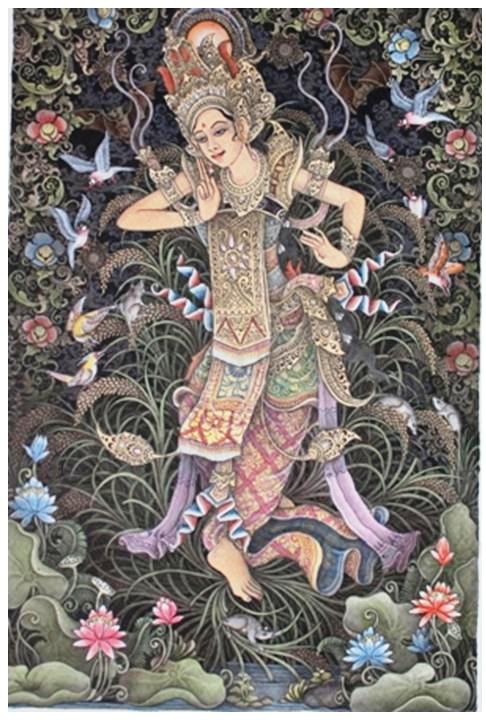
Putu has struggled against heavy odds to become a painter. Born into a very poor family, in Payogan, Kedewatan, Ubud, she was struck with polio at the age of two years old, and lost the use of her legs. A year later her father died, causing even more hardship for her family. Putu had no school education, other than what she could pick up from the other children when they came home from school. However, she has a thirst for learning, and has not only learned to read and write for herself, but she begged an artistic uncle to teach her to paint.
Putu's work is in some famous collections in Indonesia. She has a fairy-tale like simplicity of theme, and is now developing her own palette with lovely soft and sweet colours.. She has a very pleasing delicacy of line and tone, and a strong imagination/memory for life outside the home.

'I love painting so that, although my disability made schooling impossible for me, I can live from my work. I have painted since the age of 7, and learnt from my uncle who was also a painter'. 


The Senang Hati Foundation, also known as Yayasan Senang Hati, is a non-profit organization in Bali that assists people living with disabilities. The name Senang Hati loosely translates as 'Happy Hearts' in Indonesian. The foundation creates programmes to develop self-confidence, physical and economic independence, and increase awareness in the general community of the rights of people with disabilities. Senang Hati accomplishes this through the assistance of volunteers, who provide skills training and social interaction. The society also provides wheelchairs and housing, and runs Senang Hati Places, a home for disabled children.

After contracting polio at a young age, Putu Suriati, the founder of the Senang Hati Foundation, lost the use of her legs. While house-bound, Suriati was taught to paint by her uncle, and she was able to make a living selling her works to tourists–until the mid-1980s, when competition made painting unprofitable for Suriati. Things changed in 1989, when she was given a wheelchair by Judy Slatum. The wheelchair gave her increased mobility, allowing her to leave her parents' house, and giving her the opportunity to join with other female painters in Bali to form the Seniwati Gallery.

In 2000 Suriati held an exhibition of her work at the Bali Beach Hotel. At this exhibition Suriati met a number of other people with disabilities, and this led to the development of an informal network with others suffering from disabilities, which encompassed visits, activities, and excursions. With Vern Cork's arrival, (an Australian who was similarly a wheelchair user), the program was expanded, and grew to the point where they contacted the Bali Hati Foundation for assistance.

With the help of the Bali Hati Foundation, the Senang Hati Foundation was established through a notary as a non-profit organization. In 2003, the foundation moved into a vacant school through a five-year lease donated by American businessman Glen Adams.


http://en.wikipedia.org/wiki/Senang_Hati_Foundation

Tuesday, March 12, 2013

silent story

when the mother earth is finally in
deep silence

and all we hear is
the nature sound within ourselves

that would be

the day of silence


~ cerita sunyi

menghirup kegelapan
hembuskan kata hati

menyapa bintang
wahai
binarmu didiamku
bercerita

dentang nista
gema dosa
siulan sesal
tak bersuara

selagi senyap itu ada

Thursday, February 28, 2013

Bali's Day of Silence - Nyepi

Balinese holidays and temple anniversary celebrations are observed once every 210 days. Practically all of these activities are intertwined with an agrarian society: planting, growing, and harvesting rice. This lunar based calendar is called the Saka and has its origins in South India. Each of the 12 lunar months ends on a new moon, called Tilem. The day after the new moon of the ninth lunar month is the Balinese version of New Year's Day, NYEPI. Nyepi is a Balinese "Day of Silence" that is commemorated every Isaawarsa (Saka new year) according to the Balinese calendar. This is a very important and strictly observed religious day. All activity in Bali comes to a virtual standstill.

Preparations for NYEPI begin the day before. At sundown, animals are sacrificed and given as offerings to the mischievous evil spirits. In many villages a slaughtered chicken is placed in front of the main gate to placate the negative forces. Afterwards, everyone - especially little boys - bang on anything that makes a loud noise-- including petroleum drums, pots and pans, and pieces of metal roofing and light firecrackers. Women go through each room of the household sprinkling it with holy water while men follow, waving flaming torches to exorcise bad spirits. Later the noisy process of husking rice is performed. Ample food is cooked to feed the family the following day. Nearly everyone stays awake all night and pandemonium takes over each Balinese village, as people alert the evil spirits with shouts, general din and flame.

Virtually all of Bali’s residents use the night before Nyepi to take to the streets and compete to see who has produced the most fearsome three and four meter high paper mache “ogoh-ogoh” (monster). They represent demons and foul spirits who must be exorcised before the coming dawn of purification and introspection.

At dawn there is silence, as NYEPI's observances begin and continue for the next 24 hours. For all Balinese, NYEPI is a time to reflect on the past year and any transgressions that may have been made. People also contemplate on how they can become a better person in the New Year. It is a day of silence, prayer, fasting and meditation. The Balinese are forbidden to light fires or use electricity; drive or go for a walk outside; listen to the radio or watch television. Family members speak in lowered tones. Priests and higher caste members fast and do not take a drink.

Some people have been led to believe that by creating an appearance of absolute calm and abandonment, the few stubborn evil spirits that still remain after the previous day's exorcism drift away. Hindu scholars explain differently. The noise on NYEPI is not designed to scare the demons away, but intended rather to wake them so they will take note of the offerings that have been laid for them. The quietude on the day after is not intended to trick the bad spirits into thinking that everyone has left, rather it is a matter of a symbolic showing of how the forces of evil are satisfied and will not bother anyone -- at least for a while, anyway.

NYEPI commands profound devotion from the Balinese people.

The effect of these prohibitions is that Bali’s usually bustling streets and roads are empty, there is little or no noise from TVs and radios, and few signs of activity are seen even inside homes. The only people to be seen outdoors are the Pecalang, traditional security men who patrol the streets to ensure the prohibitions are being followed.

Although Nyepi is primarily a Hindu holiday, non-Hindu residents of Bali observe the day of silence as well, out of respect for their fellow citizens. Even tourists are not exempt; although free to do as they wish inside their hotels, no one is allowed onto the beaches or streets. All vehicular and pedestrian traffic outside is severely restricted, except in the case of an emergency. The only exceptions granted are for emergency vehicles carrying those with life-threatening conditions and women about to give birth. Due to government regulations there will be no tours or transportation available. Based on Bali's government instruction on "Nyepi Day", all television channel provider will disconnect broadcast temporarily. To observe this important holiday, the Ngurah Rai International airport is closed for arrival and departure that day.

~ March 12, 2013


Sunday, February 24, 2013

Hotel's Mobile Application

What to Avoid When Creating an App for Your Hotel
This article was originally going to be titled "Inspiration For Your Hotel's Mobile App" but sadly, after doing some research on hotel apps, we decided to change the title to "What To Avoid When Creating An App For Your Hotel."
It's important that when you begin something as important as a mobile app, that you are not only using your money wisely, but you are creating something guests will actually use, not something frustrating that leaves them asking why you even built it in the first place.
Whether your building the app alone or working with a developer it is important you AVOID the following.

Avoid Forgetting About The Basics

This one might seem a bit obvious, but sadly most of these mistakes are. Your home page should not be blank and the app's buttons should all go exactly where they say they will. Somehow a couple of these broken apps always make it to the App Store.
Your guests should be able to quickly locate the place inside your app where they can contact you, get more information, find attractions, etc.
Also consider your splash screen and background, if it's not visually appealing or doesn't makes sense, you've already lost their attention.
 

Avoid Large App Size

Do not create an app that requires a ton of space on your guests' phones. Not only will they need to actually have the space on their phone, they will need Wi-Fi to download your app.
Ensure your app is under 50 MB so they can download it while on the go with their cell phone's connection.
As you can see the app here is 200MB! There is no way guests will want to wait around for the app to load or even let that app take up precious space on their phone.
This is a discussion that should be had with your developer before a line of code is written.


Avoid Having Nothing for Guests

Remember who the end users will be, it's your guests, having hotel information and amenities is a good start, but they need and want more.

Do not just list your amenities and services, you want to show them how great you are, not tell them. Having the app centered around their needs is the perfect way to show and not tell.

Avoid using boring, plain text. Be sure to include some images and and/or videos, if your app looks the one here, you'll instantly loose their attention and your app will be deleted faster than it took them to find it.


Avoid Poor Design
Making sure your app is visually appealing and that is consistent with your hotel's style is very important.
If your app looks like it was designed by children or if the design is confusing, no one will ever use it, even if it has great content.
Avoid using the same icon everywhere or icons that are taken from Google Images like in these examples.


Avoid Dead-Ends

We touched lightly on this earlier, but usually it's not the home page that is blank, it is a random section of the app.
Make sure you guests don't get frustrated by pointing them to dead ends inside your app that have zero content.
If you create a section, make sure there is something there, or get rid of it!

Worse Than Dead-Ends. Dead-Ends With No Way Out

This is probably the biggest mistake you can make when creating app, you send the user to a place they can't get back from and it renders your app useless. Unless the guests is tech savvy and knows how to kill an app then restart it, they will never be able to get back to the rest of the app.
The example here shows a map inside a hotel's app, howeverthere is no way to go back to the other parts of the app, it is frozen which leaves the user frustrated and confused.
Make sure there is always a back button of some kind that is easy to locate.


Avoid Using Unnecessary External Websites

This example is attempting to use the Google Maps website inside of the app, instead of being sent to a map, the user sees this landing page promoting them to download Google Maps. This not only prompts them to leave your app but it also makes for a horrible user experience!You can avoid this by ensuring maps are embedded in your app and that you are not taking a shortcut and accessing an external site.
Aside: If you are a Marriott property, know that when you try to send users to any Marriott webpage on their phone, it will re-direct them to Marriott's mobile home page every time, which can be frustrating.


Avoid Wasting Money On Features You Don't Need
Why spend your money on things like notepads or games inside your app? You can guarantee if these are things that interest guests, they already have better apps on their phones.
Your app should be relevant and helpful. Be sure to only include features that will benefit your guests and your property, otherwise it is waisted time and money.
If you want your hotel's app to be successful, avoiding these mistakes will get you started in the right direction.

http://ehotelier.com/hospitality-news/
Feb 25, 13 | 12:06 am

Friday, February 22, 2013

The Wine

THE RESTRAINED RICHNESS of champagne wines owes a lot to the cold climate of northern France. Over time the region's wine makers have created their own techniques to overcome the cold winters and short growing seasons. The fact that the grapes ripen very slowly has its benefit too, as the grapes have time to pick up important favouring components. But when the grapes are harvested, they are rarely ripe enough to make table wine without the addition of inordinate amounts of sugar. The producers have gotten around this by making a wine low in alcohol and then putting it through a second bottle fermentation to raise the alcohol and add the bubbles.

The bubbles in champagne are a natural phenomenon that is today a managed affair. The second fermentation in the bottle causes the bubbles. When the cork is removed, the result is upwardly mobile bubbles of carbon dioxide making their escape.

Three grape varieties are used in Champagne — Pinot Meunier, Pinot Noir and Chardonnay. Pinot Meunier dominates the vineyards, growing on about 40% of the total acreage It is easier to grow and is less prone to frost damage. This grape makes up the base wine for all but the very finest champagnes and is grown only in Champagne. Pinot Noir is second with about 35%. It is responsible for the depth of fruit and longevity of the wine. Chardonnay accounts for the remaining 25% and adds lightness, elegance and breeding to the blend. The lack color in most champagne is the result of a gentle pressing, so as to extract the juice but not the color of the black grape skins.

The chief difference between the various Champagne brands or houses, is in the making of the cuvéee, or the blend, as introduced by Dom Pérignon. A house builds a reputation based on the particular style of blend of its nonvintage wines. So each year the wine must be consistent. The large houses store millions of gallons of wine from various vineyards and grapes for blending purposes. It is reasonable to assume that once you find a house style you like, it will be available year after year as long as that house exists.

The theory of producing a great champagne is to blend together the best qualities from each of the best grapes grown in the region. The blending of the still wines before the second fermentation called the assemblage and the wine and sugar that is added after the second fermentation and aging called the dosage, are the two most important steps in the determination of the house style.

In especially good years, some vintage champagne is produced. Some feel that the extra depth in taste is well worth the extra cost of these wines. Eighty percent of the contents of vintage champagne must contain grapes from the declared year. Not all of the grapes from a declared year go into vintage champagne. Twenty percent are held back to be used for blending purposes.

The sugar content of the dosage added after the second fermentation will determine the wine's style and relative sweetness. Thus you will find champagnes labeled by their sugar content. They are as follows:

Extra Brut, Brut Sauvage, Ultra Brut, Brut Intégral or Brut Zéro — These wines are bone dry with less than .6% of residual sugar per liter. In this case the dosage is of the same wine and not the usual solution of cane sugar and still wine. This wine is rarely made.

Brut — This is the most popular style of champagne.
The best blends are always reserved for the brut and is the mainstay of the business. It has less than 1.5% residual sugar and is very dry.

Extra Dry, Extra Sec — Sweetened with 1.2 to 2% residual sugar per liter, it is dry. It goes well with desserts and wedding cakes.

Sec — Although it means "dry" in French, it means "moderately dry" or "slightly sweet" as it pertains to champagne. It has 1.7 to 3.5% residual sugar per liter.

Demi-Sec — This style is distinctly sweet or medium sweet and is rarely seen in the United States. It contains between 3.3 to 5% residual sugar per liter.

Doux — This is the sweetest style of champagne. It is very sweet and is more of a dessert-style wine. It has a minimum of 5% residual sugar per liter.

Occasionally you will find Blanc de Noirs. This style is made entirely from black grapes but is white. It offers a wine that is fuller than those with Chardonnay in the blend. More often you will encounter a Blanc de Blancs. This wine is made exclusively from the Chardonnay grape and is the most delicate of champagnes. As only 25% of Champagne is planted with Chardonnay, it is generally a more expensive option.

Champagne is bottled in 10 different sizes:
Quarter bottle
– 18.7cl / 6.3 fluid ozs
Half bottle
– 37.5cl / 12.7 fluid ozs
Bottle
– 75cl / 25.4 fluid ozs
Magnum (two bottles)
– 1.5 litres / 50.8 fluid ozs
Jeroboam (four bottles)
– 3 litres / 101.6 fluid ozs
Rehoboam (six bottles)
– 4.5 litres / 147 fluid ozs
Methuselah (eight bottles)
– 6 litres / 196 fluid ozs
Salmanazar (12 bottles)
– 9 litres / 304.8 fluid ozs
Balthazar (16 bottles)
– 12 litres / 406.4 fluid ozs
Nebuchadnezzar (20 bottles)
– 15 litres / 508 fluid ozs

 Only the half-bottle, bottle and magnum are always released in the bottle in which they underwent the second fermentation. For this reason and because it is the largest of the three, the magnum is the preferred size. The three largest sizes are rarely made today.

Thursday, February 21, 2013

The History of Champagne

CHAMPAGNE WAS A REGION long before it was a sparkling wine. The region lies at a crossroads of northern Europe – the river valleys leading south to the Mediterranean and north to Paris, the English Channel and Western Germany – and thus has been the setting of many dramatic events in the history of the French nation. As a convenient access point, it has been for hundreds of years, the chosen path of many invaders including Attila the Hun. The Hundred Years' War and the Thirty Years' War brought repeated destruction to the region as armies marched back and forth across its landscape. By the 17th century, the city of Reims has seen destruction seven times and Epernay no less than twenty-five times.

But crossroads also bring trade. Champagne gained importance in its own right, during the middle ages as a center of European trade. The medieval counts of Champagne were wise enough to encourage commerce and strong enough to protect the traveling merchants. They created the then famous, Fairs of Champagne. Though these fairs were mainly about cloth, they were of obvious benefit for the wines of Champagne as it gave them easy exposure and access to important wine markets.

Champagne also benefited when the cathedral at Reims was chosen in 987 AD, as the coronation site for the French king Hugh Capet and establishing Reims as the spiritual capital of medieval France. In fact, thirty-seven kings of France were crowned there between 816 and 1825. The monasteries in Champagne with the economic assistance of the crown, were to make wine production a serious venture until the French Revolution in 1789.

Before the mid-1600's there was no Champagne as we think of it. For centuries the wines were still wines and were held in high regard by the nobility of Europe. But the cool climate of the region and its effect on the wine making process was to play an important part in changing all of that.

We owe a lot to Dom Pérignon as any inventor owes those who have come before him. He is not however the inventor of champagne as is often thought. Pierre Pérignon was a Benedictine monk who, in 1688, was appointed treasurer at the Abby of Hautvillers. The Abby is located near Epernay. Included in Dom Pérignon's duties was the management of the cellars and wine making. The bubbles in the wine are a natural process arising from Champagne's cold climate and short growing season. Of necessity, the grapes are picked late in the year. This doesn't leave enough time for the yeasts present on the grape skins to convert the sugar in the pressed grape juice into alcohol before the cold winter temperatures put a temporary stop to the fermentation process. With the coming of Spring's warmer temperatures, the fermentation is again underway, but this time in the bottle. The refermentation creates carbon-dioxide which now becomes trapped in the bottle, thereby creating the sparkle.

For Dom Pérignon and his contemporaries, sparkling wine was not the desired end product. It was a sign of poor wine making. He spent a great deal of time trying to prevent the bubbles, the unstableness of this "mad wine," and the creation of a decidedly white wine the court would prefer to red burgundy. He was not able to prevent the bubbles, but he did develop the art of blending. He not only blended different grapes, but the juice from the same grape grown in different vineyards. Not only did he develop a method to press the black grapes to yield a white juice, he improved clarification techniques to produce a brighter wine than any that had been produced before. To help prevent the exploding bottle problem, he began to use the stronger bottles developed by the English and closing them with Spanish cork instead of the wood and oil-soaked hemp stoppers then in use. Dom Pérignon died in 1715, but in his 47 years as the cellar master at the Abby of Hautvillers, he laid down the basic principles still used in making Champagne today.


Although sparkling Champagne was only about 10% of the region's output in the 18th century, it was enjoyed increasingly as the wine of English and French royalty and the lubricant of preference at aristocratic gatherings. Its popularity continued to grow until, in the 1800's, the sparkling wine industry was well established.
The face of the industry really began to change when Louis XV allowed the transport of wine in bottles in 1728. A year later, Ruinart became the first recorded Champagne house. By 1735, a royal ordinance was instituted to dictate the size, shape, and weight of champagne bottles, the size of the cork they should use and that they be secured with strong pack thread to the collar of the bottle. Claude Moët founded, in 1743, what was to become the largest champagne house today, the House of Moët.

The complexity and capital intensity of making champagne ultimately lead to the replacement of the monastic and aristocratic growers with the champagne merchants. With their capital, the merchant's or maisons, had to ability to perfect the otherwise still unpredictable fermentation process, age, distribute, market and export the wine.


Dégorgement was first practiced in 1813. It was perfected in 1818 by the Widow Clicquot's cellar master Antoine Muller. He developed a process of "riddling" the wine in order to get the sediment of dead yeast cells into the neck of the bottle so it could be removed without the time consuming task of decanting each bottle. This process also saved most of the gas.

The 1820's and 30's saw the use of corking machines and wine muzzles. Finally in 1836, a pharmacist in Châlons-sur-Marne, M. François, invented an instrument, called a sucere-oenomètre, to measure the amount of sugar in wine. With this invention, the amount of sugar needed to stimulate the second fermentation could be reliably determined, and the bottle burst-rate dropped to 5%. It was now a little more safe to take a spring walk through a champagne cellar.

In the 1920's four well known houses were established – Bollinger, Irroy, Mumm, and Joseph Perrier. By 1853 total sales of sparkling champagne reached 20 million bottles up from just 300,000 bottles at the turn of the century.
World War I again brought devastation to the region. The early months of the war saw a rapid German advance into northern France and during the fall of 1914, they were camped south of the river Marne. By 1915 they were driven back just north of the city of Reims. The enormous caves – Roman chalk quarries – beneath Reims that were used for the storage and production of champagne, now became shelters from the 1000 days of bombardment the city endured from 1914 to 1918. After the war, the city had to be completely rebuilt.
The years after the Great War were difficult. The Bolshevik Revolution in Russia, Prohibition in the United States, and then the Great Depression saw the champagne market dry up. The champagne houses stopped buying grapes, so the growers formed the first champagne cooperatives at this time. With the ending of Prohibition in 1934, the industry began to turn around. The influential head of Moët & Chandon, Robert-Jean de Vougë, was most instrumental in securing its future. He proposed that the purchase price of champagne grapes be set at a level that ensured a decent living for the growers, and in 1941, during the German occupation of France, became the driving force in persuading the Germans to establish the very successful Comité Interprofessional du Vin de Champagne – C.I.C.C.

Since World War II champagne sales have climbed upwards, nearly quadrupling between 1945 and 1966. Champagne has trickled down the social scale and is no longer considered just a luxury. Today, more champagne is being drunk, by more people, than at any previous time in history. The new millennium looks good for champagne.

http://www.intowine.com/

Wednesday, February 13, 2013